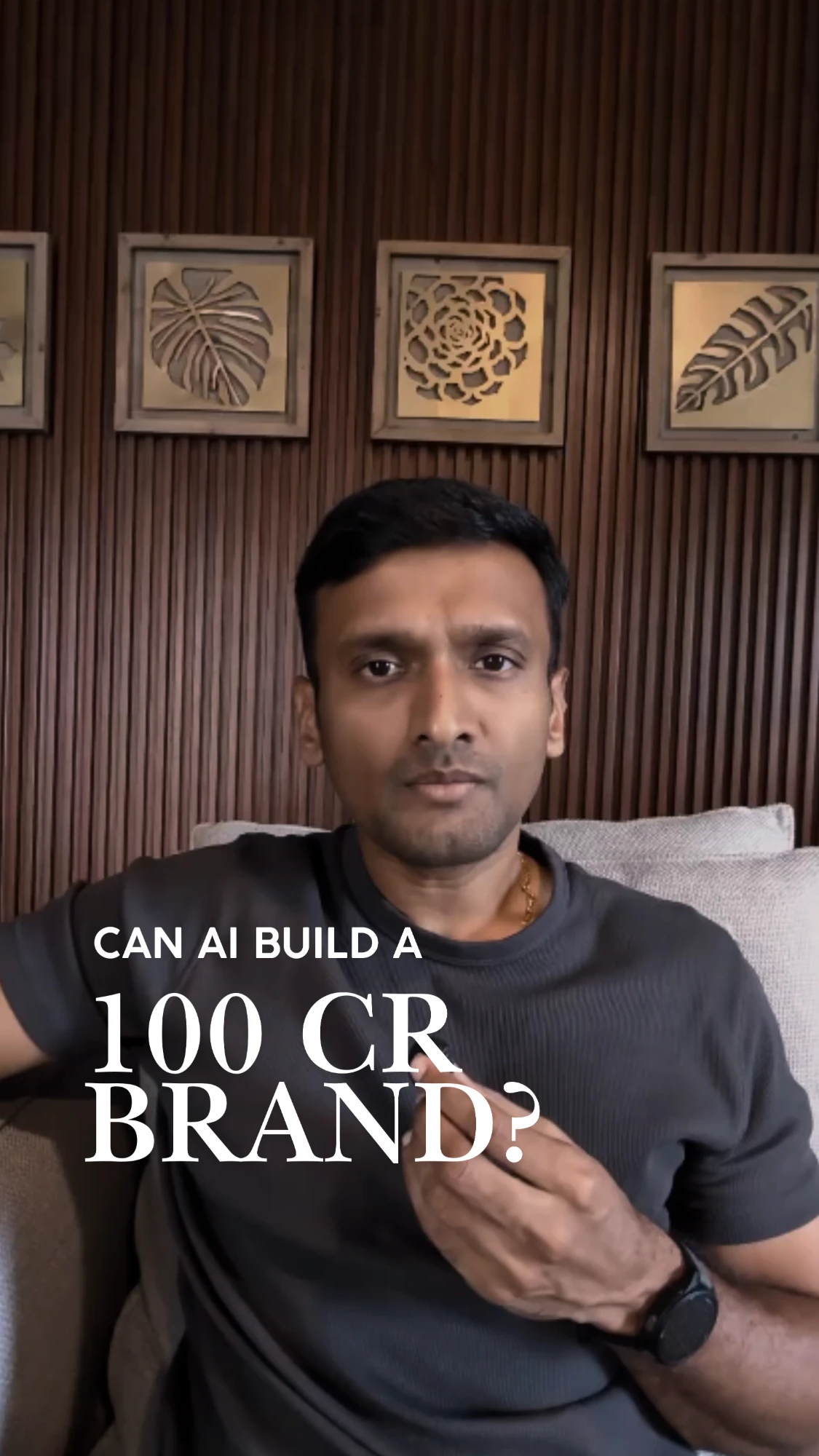
How I plan to build a 100 crore D2C brand as a solo founder
A solo founder does not need to do every job alone. The real advantage is having one person own the important decisions while partners, people, and software handle repeatable work. Over the next 100 days, I am using that idea to work through a D2C brand from zero orders to a repeatable operating system.
I am starting from zero. This is not a claim that a 100 crore brand is easy, guaranteed, or built by one person working without help. It is a practical question: how much of a brand can one focused founder build when the work is organised properly?
What does “solo founder” actually mean?
It does not mean manufacturing products at midnight, packing every order, answering every support message, and reconciling every payment forever.
It means one person owns the direction of the business: the customer, the problem, the product, the promise, and the money. A manufacturer, courier, accountant, creator, logistics partner, or software tool can support those decisions. The founder still owns the outcome.
The useful question is not, “How many employees do I have?” It is:
Which decisions must stay with me, and which repeatable tasks can be supported by people, partners, or software?
Why is a solo-founder D2C model more practical now?
Every brand has repetitive work: writing listings, checking orders, grouping customer questions, reviewing ads, updating inventory, collecting reviews, and following up with suppliers.
Software can help organise that work. It can draft a product description, group review themes, prepare a report, or flag a stock issue. But it cannot decide whether the product is genuinely useful, inspect every sample properly, or take responsibility for a misleading claim.
That is the distinction I want to keep throughout this series: tools can reduce repetitive work, but judgement remains the founder's job.
The 100-day roadmap
| Stage | Milestone | What I will work through |
|---|---|---|
| 1 | Define the brand | Category, customer, problem, positioning, sourcing, and unit economics. |
| 2 | Get the first order | Storefront, product page, payments, shipping, trust, and first marketing tests. |
| 3 | Work towards 100 orders a day | Contribution margin, acquisition, inventory, fulfilment, support, and retention. |
| 4 | Understand 1,000 orders a day | Forecasting, marketplaces, warehouses, reconciliation, cash flow, and systems. |
These are learning milestones for the series, not a promise of business performance. The goal is to understand what changes as volume grows and where a founder becomes the bottleneck.
Why I will do the manual work first
If I want to understand a customer, I will read the reviews and complaints myself before asking a tool to group them. If I want to understand a competitor, I will look at the products, prices, pages, reviews, and offers before automating the comparison.
If I want to understand unit economics, I will write down the costs and calculate the contribution manually before testing scenarios in a spreadsheet.
Otherwise, I am only automating confusion. The faster method is useful after I understand the task it is helping me do.
The first decision is not the logo
Before I choose a name or design packaging, I want to answer:
- Who has the problem?
- When does it become urgent?
- What do customers use today?
- What do they dislike about current options?
- Are they already spending money?
- Can I serve a narrow customer better than a generalist?
- Can I deliver the product with enough margin left?
Tomorrow, I will start with the category decision. I will look at demand signals, marketplace behaviour, competitor activity, and the difference between an interesting idea and a category worth testing.
What would I do tonight if I were starting from zero?
I would write down three categories I already understand, the customer I think each category serves, and the problem I believe is worth solving. Then I would separate what I know, what I am assuming, and what I need to verify.
I would not start by asking an AI tool to invent ten product ideas. A prompt cannot replace the starting point. It can help me challenge it.
Frequently asked questions
What does solo founder mean in a D2C business?
It means one person owns the important business decisions. It does not mean doing every task alone.
Can one person really build a 100 crore D2C brand?
A highly leveraged business can be built around one decision-maker, but the target is not guaranteed. The product, customer demand, economics, and operations still have to work.
What should I do before choosing a product?
Define the customer problem, current alternatives, evidence that people pay, possible differentiation, and the product economics before buying inventory.
Should I use AI before understanding the problem?
No. Understand the customer and the numbers manually first. Then use software to organise repeatable work and test scenarios faster.
Evidence note: This is a worked educational series. The four stages and order milestones are the structure of the exercise, not a forecast or guarantee.
If you were starting from zero today, which category would you investigate first, and what makes you believe the customer problem is real?